
The digitalization of asset management, including resources, sustainability, design, talent, leadership, governance, etc., is now key to achieving maximum efficiency of spaces, whether a building, a company or a city.
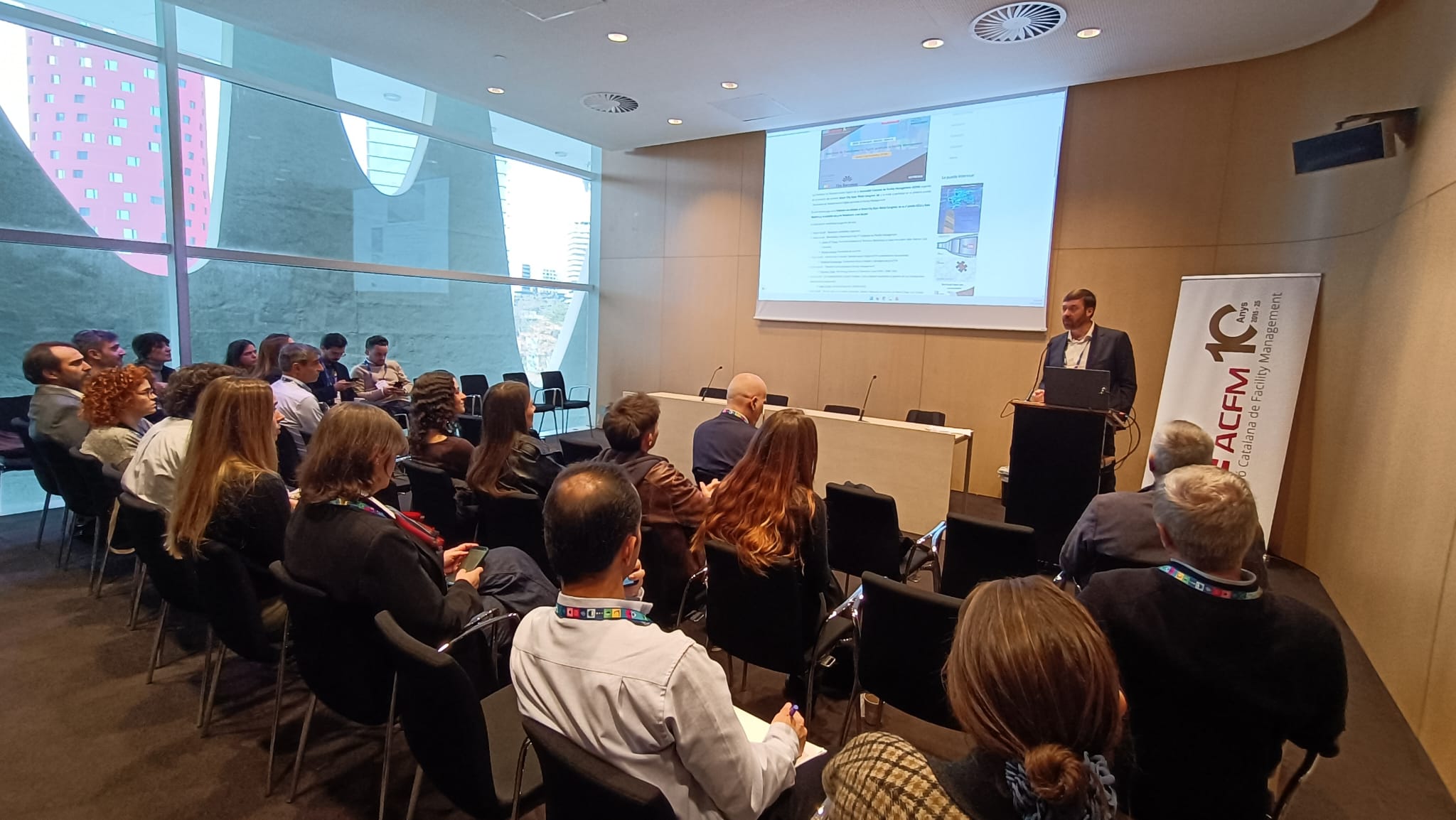
This is the main conclusion of the experts who attended the conference “Digital Transformation Solutions Applied to Facility Management,” organized by the Catalan Facility Management Association (ACFM) as part of the Smart City Expo World Congress held in Barcelona. This was the last site event before the 1st Facility Management Barcelona 2026 Congress, to be held on 25-27 November.
In recent years, technology, data and innovation have been transforming operational efficiency, service quality and decision-making in facility management, both public and private.
In this regard, the president of the ACFM, Manuel Járrega, stated that “the use of artificial intelligence, virtual reality, digital twins and platforms is changing the management of spaces and infrastructures.” He made clear that cities are “smarter when they use technology for the benefit of people, since better energy, environmental and asset management, etc. brings more well-being to their population.”
This technological progress requires a parallel cultural change in companies and institutions, so that Facility Management becomes part of their core business. Organizations must make a comprehensive commitment, as experience shows that isolated implementation (by department, site, area, etc.) does not work.
Only in this way will profitability be achieved. Josep Mª Piqué, executive president of Technova Barcelona–La Salle Innovation Park–Ramon Llull University, noted that “to maximize assets, spaces must be digitalized, but so must governance,” adding that “what happens on the ground must be in the cloud, and what happens in the cloud must be controlled in order to have an impact on and intervene on the ground.”
All the success stories presented during the event followed this line. They showed how innovative technological solutions are helping companies and public institutions not only to optimize resources, but also to prevent problems or detect them early enough to solve them and eliminate or reduce their impact, thereby achieving better returns on assets.
Success stories
Francesc Trisan, Head of Technology for the EMEA region at CBRE GWS, spoke about “Virtual Reality Applied to Facility Management,” presenting a product for the maintenance area that adapts to the use and features the technician requires, bringing transparency to the entire inspection or repair process. For Trisan, “Virtual reality helps us see and analyse what we do at all times, whether for auditing or training purposes.”
Asier Carrión, account executive at INFRASPEAK, explained how the Dreamfit gym chain achieved traceability that gave it full knowledge of the management of the assets in its sports centers through incident monitoring, and a replicable model that “means it doesn’t have to be modified as the number of facilities grows, because integration is automatic.”
The comprehensive management of a city’s assets was addressed by Nicolás Perelló, Business Director at NLS Group, who stressed that a smart city is not achieved by accumulating isolated applications, but by integrating the information and management of its assets into a global vision. As an example, he presented the case of Miami-Dade County, where Octave’s Attune EAM platform is used across different public services, such as water, transport and the airport, among others. This technology makes it possible to integrate existing systems, centralize asset information and move toward coordinated management of their entire life cycle, optimizing maintenance, costs, risks and the quality of services to citizens.
Álex Rubio, Head of Projects and Institutional Relations at FAMA/480, also contributed to the understanding of asset management in the public sector, referring to the application of AI to the management of municipal facilities. He indicated that “implementing the use of AI should not be the first step; what must be considered first is knowing what you have, because this technology, in order to learn, needs digitalized data classified using the same name for each type. For example, all breakdowns must have a specific designation.”
The industrial sector focused the technological transformation of Facility Management on prevention and on how predictive maintenance improves operations and can help streamline processes. For this, the event featured Daniel Cascante, IoT business manager at BECOLVE, who stated that “data must become information that allows you to act in advance. There are devices and platforms through which various indicators can be monitored that give signals of what may happen, thus preventing the problem from occurring.”
Cybersecurity cannot wait
Data connectivity and management through real-time platforms are a risk factor for cyberattacks, to which the industrial sector is particularly vulnerable.
Therefore, to avoid cases like the recent cyberattacks on the refrigeration chain of European supermarkets and on the French public blood bank, carried out through the systems of an external provider, a cybersecurity system is necessary.
In this regard, the professionals taking part in the conference agreed on the urgent need for a cultural change in companies and for investment in the design and activation of cybersecurity systems and plans, because “we don’t know how far AI can go; we are learning as things happen.”