

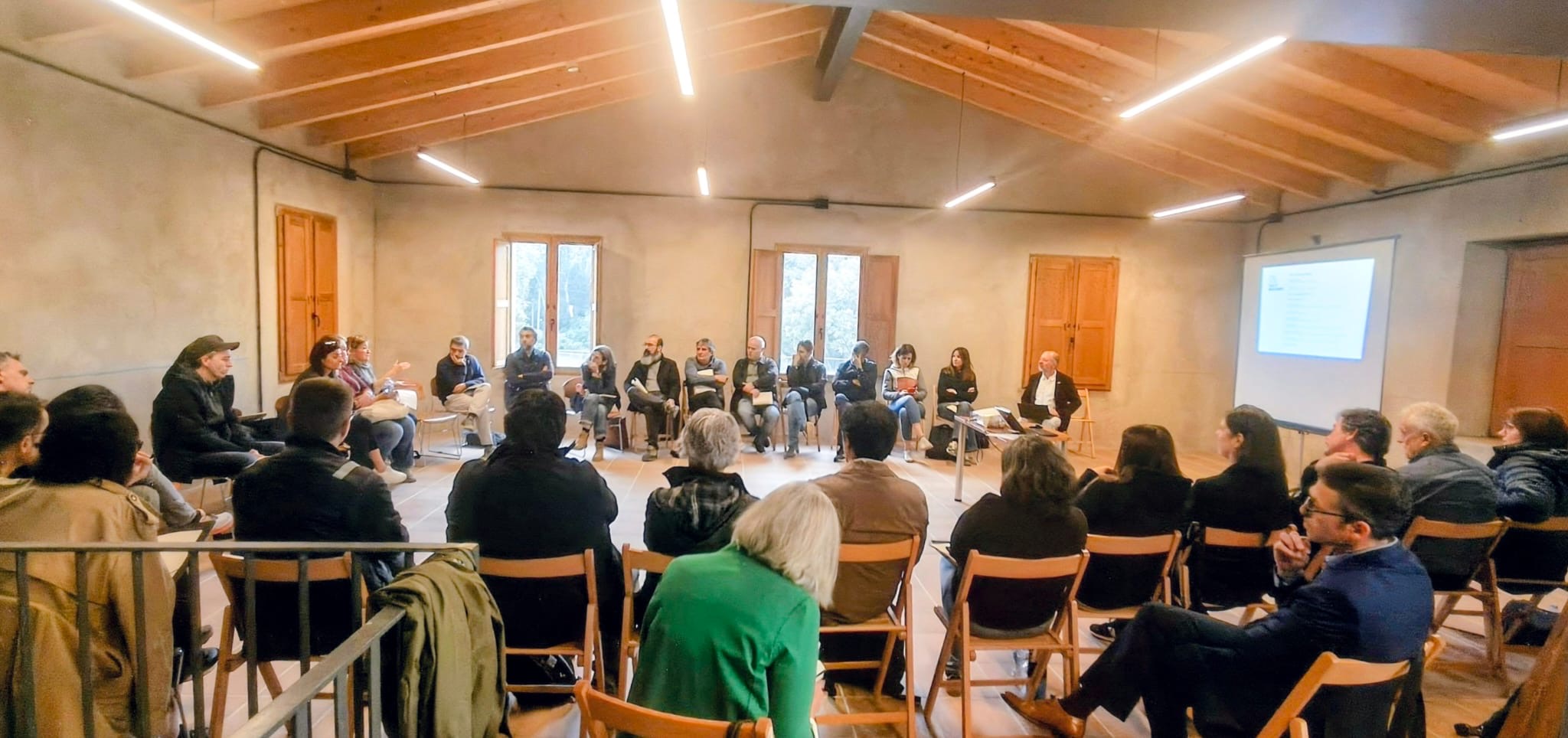
Coinciding with World Facility Management Day, on 13 May the Can Bosc del Far estate, located in the Carrilet and Corredor Natural Park in Dosrius, hosted a day of debate and reflection devoted to the role of Facility Management in sparsely built environments.
The event brought together professionals and representatives from public administrations, professional associations, foundations, organisations and companies to analyse the causes behind the abandonment of these areas and explore possible ways of restoring them from an integrated management perspective.
The event forms part of a programme of activities being promoted this year by the Catalan Facility Management Association (ACFM) in the lead-up to the 1st Barcelona Facility Management Congress, which will take place on 25, 26 and 27 November at the Sant Pau Art Nouveau Site. The congress is being jointly organised by the ACFM, Barcelona City Council, the Architects’ Association of Catalonia (COAC) and the Government of Catalonia. It coincides with Barcelona’s designation as World Capital of Architecture and with the International Union of Architects Congress.
Facility Management is the discipline responsible for managing built environments and their supporting services throughout their entire life cycle. However, the event highlighted that its knowledge, methodologies and tools can also play an important role in areas with low building density, where the management of resources, built heritage and ecosystem services is becoming increasingly important.
A relevant discipline for areas with low building density
The event was attended by 35 professionals and representatives of organisations involved in territorial management, heritage, architecture, engineering, sustainability and nature conservation. The institutional welcome was delivered by José Santaella, director of the Carrilet and Corredor Natural Park, and Felip Neri Gordi, a board member of the Catalan Facility Management Association.
The day began with a guided tour of the natural surroundings and the restored Can Bosc farmhouse, a project that demonstrates the potential for restoring and enhancing heritage in rural and natural settings.
Participants then took part in an open debate featuring contributions from Albert Abaurrea, Marta Lloret, Josep Maria Dilmé, Núria Vila, Ramon Calonge and Lluís Dalmau. They represented a range of fields related to territorial management, heritage, architecture and engineering.
Towards an integrated, cross-cutting approach to sparsely built areas
The different contributions highlighted the complexity of the factors that have led to the gradual abandonment of sparsely built areas over recent decades. The main barriers identified included economic difficulties, regulatory and bureaucratic constraints, a lack of services and infrastructure, fragmented information, insufficient applied innovation and the coexistence of legitimate but often conflicting interests among the various stakeholders involved.
One of the main points of consensus was the need for a more integrated and cross-cutting approach to managing these areas. Participants agreed that Facility Management can provide tools and methodologies capable of creating the conditions needed to make certain rural, natural and heritage environments more liveable, sustainable, economically viable and beneficial to society as a whole.
Green infrastructure and ecosystem services also emerged as key concepts for guiding future initiatives. These frameworks make it possible to combine environmental conservation with the management of resources and built assets, supporting territorial regeneration and the creation of social and environmental value.
Data management is key
Another key issue was the importance of information systems and data management. Reliable information on the history of buildings, their construction characteristics, maintenance costs and possible intervention options is considered essential for making informed decisions and efficiently planning actions throughout the entire life cycle of assets.
As a result of the debate, participants proposed developing a strategic plan to support the identification and cataloguing of existing sites, the analysis of potential uses, the adaptation of regulatory frameworks, the compilation of best practices and the development of shared technical solutions. This area could become one of the topics for further discussion and development over the coming months.
The Can Bosc event therefore marks another milestone in the preparatory programme for the 2026 Barcelona Facility Management Congress. Through these thematic events, the ACFM aims to broaden the debate surrounding the discipline’s major challenges and help generate knowledge that will inform both the congress and the forthcoming book Facility Management and Architecture.